ECB Financial Stability Risk Dashboard—2025
Euro Area Systemic Risk Overview
Executive Summary
The ECB’s Financial Stability Review (Nov 2024) highlights persistent macro-financial and geopolitical uncertainty, with risks shifting from inflation to growth. While euro area banks remain resilient, vulnerabilities are rising in sovereign, corporate, and non-bank sectors. Market volatility and policy uncertainty remain elevated.
Key Risk #1
Macro-financial/geopolitical shocks & market volatility
Key Risk #2
Sovereign and corporate debt sustainability
Key Risk #3
Non-bank financial sector liquidity & leverage
Macro-Financial & Market Environment
Uncertainty remains high due to geopolitical tensions and shifting monetary policy. Market volatility has increased, with sharp corrections in equity and bond markets. Policy rates remain elevated, and central bank balance sheets are gradually normalizing.
Market Volatility
Global Interest Rate Environment
Central Bank Balance Sheets
Economic Growth Forecasts
The European Commission has significantly cut its growth forecasts for the Eurozone as US trade policy creates economic disruption. The EU executive now expects the 20-member currency area's economy to grow only 0.9% in 2025—down from its previous estimate of 1.3%—and has reduced its 2026 GDP growth outlook to 1.4% from 1.6%.
Revised Growth Forecasts by Country
| Country | Previous 2025 Forecast (%) | Revised 2025 Forecast (%) |
|---|---|---|
| Eurozone (Overall) | 1.3 | 0.9 |
| Germany | 0.7 | 0.0 |
| France | 0.8 | 0.6 |
| Italy | 1.0 | 0.7 |
Source: European Commission Forecast, May 2025
Key Vulnerabilities by Sector
Household Sector
Household debt-to-income ratios have declined, but debt service costs remain elevated for some. Risks are concentrated among low-income and highly indebted households.
Corporate Sector
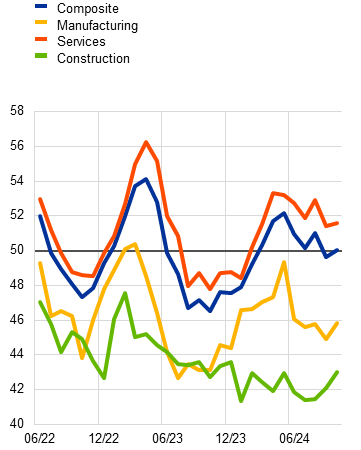
Corporate balance sheets are under pressure from high funding costs and weak growth, especially in commercial real estate and SMEs. Insolvencies are rising from low levels.

Sovereign & Market Risks
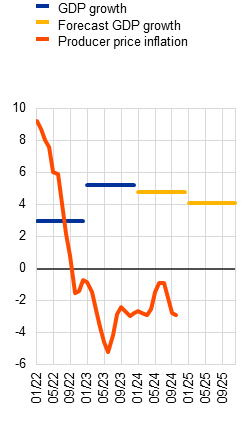
Sovereign vulnerabilities are increasing, especially in high-debt countries. Market volatility has increased, with sharp but short-lived corrections in equity and bond markets.
Banking Sector
Euro area banks remain resilient, with strong capital and liquidity buffers. Asset quality is deteriorating slowly, mainly in CRE, SMEs, and consumer credit, but exposures are manageable in aggregate.
Capital Adequacy by Country Group
Non-Performing Loan Ratio Trends
Stress Test CET1 Ratio Impacts by Country Group
Liquidity Metrics by Bank Type
European Banking Profitability Trends
European Banking System Risk Assessment by Country
Non-Bank Financial Sector
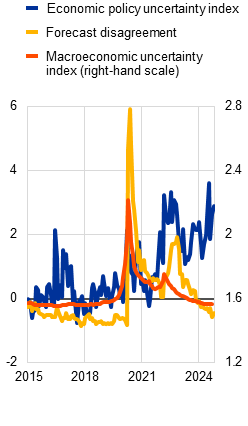
NBFIs face valuation, liquidity, and leverage risks, especially in investment funds and insurers. High concentration in equity holdings and increased exposure to US assets amplify vulnerabilities.
Climate & Emerging Risks
Climate change and transition risks are increasingly relevant for euro area financial stability. Physical and transition risks are sector-specific and evolving.
Evolution of Climate Risk Channels
Climate Risk Exposure by Economic Sector
Download Data
All charts and data from this report are available for download in multiple formats.
Further Resources
Related Risk Reports

ECB Financial Stability Review—2024
Official ECB assessment of euro area financial stability, risks, and resilience.

Macroprudential Bulletin
ECB bulletin on macroprudential policy, systemic risk, and regulatory developments.

Climate Risk & Financial Stability
Analysis of climate-related risks to euro area financial stability.